
The school management also removed all the security staffs.

The bus had gone to Delhi and was plying on the wrong side of the expressway after refilling CNG near Ghazipur border.

With communal clashes claiming six lives in parts of Haryana close to Delhi, the Supreme Court on Wednesday ordered enhanced deployment of security personnel in sensitive areas and a crackdown on hate speech, but refused to stop the proposed rallies by the Vishwa Hindu Parishad and Bajrang Dal in the National Capital Region.
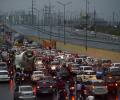
The tightening of traffic restrictions put in place to contain the spread of the coronavirus by Gurgaon and Ghaziabad administrations on their borders with Delhi led to chaos and traffic congestion on Friday.

Glimpses of the Bharat Bandh called to protest the Agnipath scheme, June 20, 2022.

The Delhi government has banned construction and demolition activities in the city till November 21.
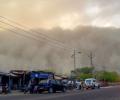
A high-velocity dust storm hit the national capital and regions of Haryana and Rajasthan. The storm, with a wind speed of 70 kilometres per hours, hit Delhi around 11.20 pm on Monday, an official at the Safdarjung observatory said. Here's a glimpse of the storm and all that it brought along with it.
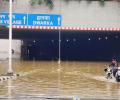
Delhiites woke up to the sound of thunder and lightning this morning and, according to the weather department, the city recorded 117.9 mm rainfall from 5:30 AM to 2.30 PM.

Road and rail traffic was partially affected in some regions on Monday during a 'Bharat bandh' called against the Agnipath military recruitment scheme, while protests appeared to taper off in many states, with authorities stepping up security and imposing curbs after days of unrest.

The Northern Railways said it has cancelled around 17 trains and diverted around 12 others, while traffic has been suspended at four locations due to waterlogging.

Trains were set afire and blocked, and public vehicles attacked as protests over 'Agnipath' swept across several places in Bihar, Uttar Pradesh, Rajasthan, Haryana, Madhya Pradesh, Delhi and Jammu on Thursday amid partisan political voices in favour and against the new recruitment scheme for the defence forces that has set off a firestorm.
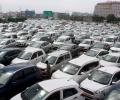
How can highways be blocked perpetually, the Supreme Court wondered on Thursday while referring to road blockades by farmers protesting at Delhi borders against the three farm laws passed last year, and said it is the executive's duty to implement the law laid down by the court.

In a statement, Delhi Health Minister Satyendar Jain said the air pollution had reached the severe level and asked people to follow the dos and don'ts as mentioned in the advisory.

Protesting farmers owing allegiance to different farmers' bodies blocked state and national highways at several places on Saturday, causing inconvenience to commuters.

The overall Air Quality Index was recorded at 231 on Sunday which falls in 'poor' category.

Defying prohibitory orders, protests were held in Delhi, Bengaluru, Hyderabad and several other cities. Protesters, mostly students and activists, were detained on a large scale in national capital and other places.

According to the Central Pollution Control Board (CPCB), the 24-hour average concentration of lung-damaging fine particles known as PM2.5 in Delhi-NCR shot up from 243 micrograms per cubic metre at 6 pm on Thursday (Diwali day) to 410 micrograms per cubic metre at 9 am on Friday, around seven times the safe limit of 60 micrograms per cubic metre.

Heavy rains on Wednesday morning caused water-logging in many areas and massive traffic jams in Hyderabad, leading to people stuck on the roads.

Either drivers were blissfully unaware of the requirement or they hadn't bothered to get one installed in their vehicle.

Massive crowds thronged liquor stores, more vehicles plied on roads and cab-hailing platforms resumed services as India entered the third phase of the lockdown on Monday with further easing of curbs except in containment zones in the shadow of the highest rate of recovery yet from coronavirus.

Incidents of arson, firing and vandalism were reported from Madhya Pradesh, Rajasthan, Uttar Pradesh, Bihar and Punjab as protesters agitated against the dilution of the SC/ST Act.

Can the country afford to have problems of such magnitude in the cities of Gurgaon, Bengaluru, Pune and Hyderabad, which not only are the major growth drivers but are also the biggest revenue contributors in their respective states?

City police, metros, airports, even power utilities are using pop culture and social media to reach the young and encourage public ownership of public services. Amritha Pillay reports.

How could India@75 improve law and order, courts, social, physical and soft infrastructure, efficient cities, e-governance, ease of doing business and other essential state functions by 2022, asks Shailesh Pathak.

Mass mobility in India is in a race when the light turns from yellow to green. Just that this moment has lasted three years. The renewed enthusiasm, however, indicates that the lights may finally be about to change, says Patanjali Pahwa.

